
Introduction
The Invisible Architect of Modern Biology.
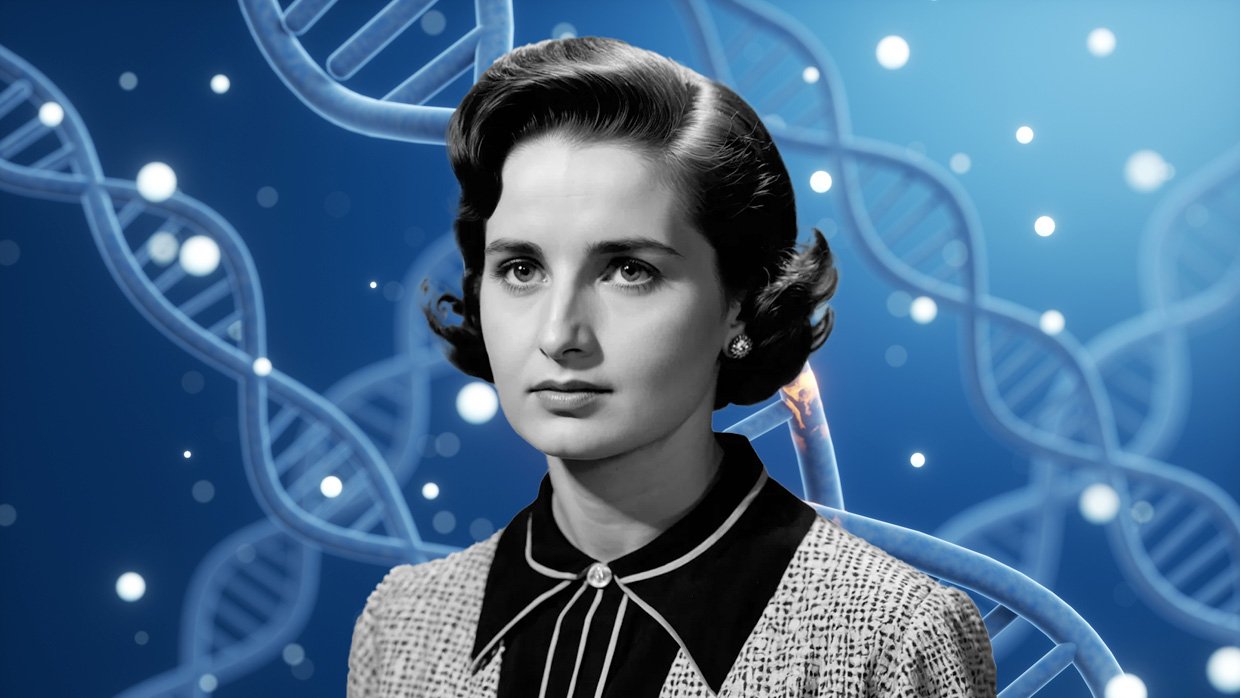
The history of science is often told as a triumphal narrative of genius, discovery, and progress. Yet beneath this celebratory surface lies a quieter, more uncomfortable truth: many foundational scientific breakthroughs were shaped by structural inequalities, exclusion, and patriarchal power. Few stories illustrate this more starkly than the life and work of Rosalind Franklin, whose contributions were central to understanding the structure of DNA, yet whose recognition was systematically denied during her lifetime.
Franklin was not merely a “supporting figure” in the discovery of DNA. She was an accomplished chemist and X-ray crystallographer whose data provided the decisive empirical foundation for one of the most important scientific discoveries of the twentieth century. Her struggle exposes how gender bias, institutional hierarchy, and informal networks of power shaped scientific credit—and how patriarchy continues to influence who is remembered as a “scientific genius.”
Rosalind Franklin: A Scientist of Exceptional Precision
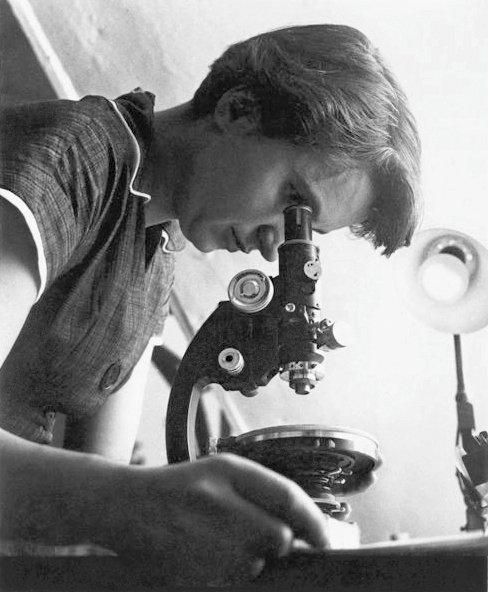
Franklin trained as a physical chemist and became an expert in X-ray diffraction, a technique requiring extraordinary technical skill, mathematical sophistication, and interpretive discipline. By the early 1950s, she was conducting pioneering research at King's College London, focusing on the structure of DNA.
Her work produced Photo 51, the clearest X-ray diffraction image of DNA ever captured. This image revealed, with striking clarity, the helical structure of the molecule. Franklin’s notebooks show that she had already deduced crucial parameters of DNA’s geometry independently, including its helical symmetry and dimensions.
Yet Franklin worked in an environment deeply shaped by gendered assumptions. She was treated as a subordinate rather than an intellectual equal, excluded from informal scientific networks, and positioned as “difficult” for asserting methodological rigor. Precision—celebrated in male scientists—was reframed as obstinacy when practiced by a woman.
Patriarchal Structures in Mid-20th-Century Science
To understand Franklin’s marginalisation, one must move beyond individual personalities and examine institutional patriarchy. Scientific research in the mid-twentieth century was dominated by male hierarchies where authority, credit, and visibility were controlled through informal networks.
Franklin’s data was shown—without her knowledge or consent—to James Watson and Francis Crick, who were working at University of Cambridge. This breach of ethical practice was normalised within a culture that treated women’s labour as communal property rather than intellectual ownership.
Watson later portrayed Franklin dismissively in The Double Helix, reinforcing stereotypes of the “difficult woman scientist.” Such narratives did not merely reflect bias; they actively produced it, shaping how generations of readers understood scientific discovery.
Recognition Denied: Credit, Power, and the Nobel Prize
In 1962, Watson, Crick, and Maurice Wilkins received the Nobel Prize in Physiology or Medicine for the discovery of DNA’s structure. Franklin had died four years earlier, at the age of 37, from ovarian cancer.
While Nobel Prizes are not awarded posthumously, the deeper injustice lies elsewhere: Franklin’s contribution was never fully acknowledged even while she was alive. The prize citation and subsequent narratives minimised her role, reinforcing the idea that scientific insight belongs to those who theorise, not those who produce rigorous empirical evidence.
This distinction itself reflects patriarchal assumptions—valuing abstract theorising (coded masculine) over experimental labour (often feminised), despite the fact that theory without data is speculation.
Critical Thinking as the Cornerstone for Academic Honesty
Critical analysis has similarities with academic integrity. Plagiarism occurs when students use external sources without thinking about the matter. Students internalise arguments, reinterpret evidence, and come up with new points of view when they start to think about ideas. This process naturally lowers the chance of unintentional plagiarism, because the work shows personal reasoning, instead of replication. As generative technologies can now make grammatically correct text at once, original work is set apart by depth of insights and thought. Surface responses may appeal but they do not have depth, intellectual tension, or an understanding of the context. Argument structure, evidence integration, theoretical engagement, and reasoned critique are areas where human critical reasoning is still very important.
The Gendered Politics of Scientific Authority
Franklin’s experience reveals how patriarchy operates in science not through explicit exclusion alone, but through subtle mechanisms:
- Control of access to credit
- Informal male networks
- Gendered interpretations of behaviour
- Narrative ownership of discovery
Women who challenge authority are often labelled uncooperative, while men asserting dominance are framed as visionary. Franklin’s insistence on methodological caution—scientifically justified—was reinterpreted as a personal flaw.
This pattern persists today. Numerous studies show that women scientists receive fewer citations, less grant funding, and diminished recognition for collaborative work, even when their contributions are equivalent or superior.
Rewriting Scientific Memory
In recent decades, Franklin’s reputation has been partially restored. She is now recognised as a foundational figure in molecular biology, with laboratories, fellowships, and awards named in her honour.
Yet symbolic recognition is not enough. Franklin’s story must be understood not as an isolated injustice, but as a structural lesson. Scientific institutions must confront how power, gender, and hierarchy shape knowledge production.
To teach science ethically is to teach its history honestly.
Conclusion: Beyond Recognition, Toward Structural Change
Rosalind Franklin was not a tragic footnote to male genius. She was a scientist of extraordinary intellect whose work transformed biology. Her struggle exposes how patriarchy distorts scientific truth by determining whose knowledge counts.
Honouring Franklin means more than correcting the record—it demands that contemporary science dismantle the structures that still marginalise voices based on gender, race, and power. Only then can science truly claim to be objective.